

Analysis and Plan for Leakage of Boiler Steam Soot Blower to Four Pipes
In recent years, it is not uncommon for the sootblower to cause leakage or thinning of the heating surface four pipes, so we should pay more attention to the sootblowing situation. As far as the company is concerned, there have been too many leaks caused by problems such as sealing at the soot blower and soot blower failure. Although there is no large-scale blowing loss, it also causes certain economic losses and lays hidden dangers for the safe operation of the unit.
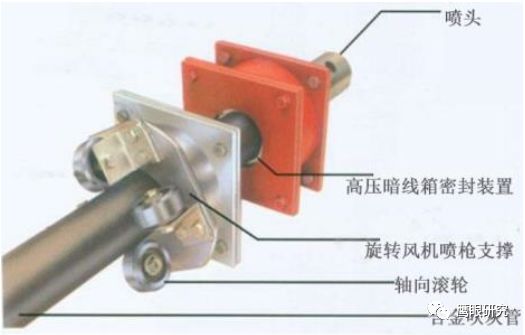
1. Working principle of steam soot blower
The soot blower is used to blow off the soot to ensure the cleanliness of the heating surface and improve the economy of the boiler. The steam is used to form a high-speed jet at the nozzle to wash the soot on the heating surface. When the impact force is greater than the adhesion force between the ash particles and the ash particles, the ash particles will fall off, most of the particles are taken away by the flue gas, and a small amount of large particles or ash blocks fall on the ash hopper or flue.
2. Leakage of four pipes related to steam soot blower
Cracks on the heating surface of the 2.1 furnace wall mainly refer to cracks on the fins or pipes around the soot blower hole. The main reason is that the poppet valve is opened too early, the blowing point is too close, the nozzle starts to blow soot before completely leaving the furnace wall, and the steam condenses around the soot blower hole, resulting in uneven cold and heat expansion and contraction. The large temperature difference between the inside and outside of the sealing plate and uneven expansion and contraction produce large stress, resulting in cracking of the water wall. The frequent leakage of the water wall at the soot blower hole of our company is related to this factor.
A large area of 2.2 heating surface is damaged by blowing, mainly due to changes in relative position and pressure, resulting in poor soot blowing effect or damage to the heating surface. When the poppet valve of the sootblower is overhauled or the spring is deformed due to long-term operation, the opening of the poppet valve will be affected and the setting pressure will change accordingly. If the pressure is set too high or not set for a long time, the operating personnel cannot effectively monitor the pressure, and the long-term operation of the sootblower will definitely cause large-area thinning of the heating surface and even cause pipe explosion.
2.3 the damage of the heating surface caused by the accident state. During the operation of the sootblower, if the emergency treatment is not timely, it will easily cause the sootblower to be jammed, and cause the pipe discharge and blow loss in a short time, accompanied by thermal stress concentration, resulting in pipe explosion on the heating surface. At the same time, in the process of treatment, if the steam source is cut off, it is easy to cause the outer tube of the soot blower to lose steam cooling, resulting in the bending of the gun head, which cannot be taken out or the falling of the gun head injures the slope heating surface of the water-cooled wall ash hopper. For example, the soot blower barrel of a power plant in our company rotates in the economizer to blow soot. Because the barrel has only one limit support, the barrel is affected by high temperature during operation, causing thermal deformation and jamming of the barrel, and the inlet valve is not closed properly, causing the economizer tube to be damaged in a short time, eventually leading to leakage of the heating surface tube.
3. Defect management scheme
Through the analysis of the above problems, we can put forward the following solutions in order to effectively control and monitor the operation of the soot blower, take protective measures, reduce the influence of the soot blower on the heating surface, improve the thermal efficiency, so as to avoid the leakage of the heating surface.
3.1, do a good job in daily soot blowing tracking, understand the dust accumulation of the heating surface according to relevant data, effectively formulate the soot blowing time, and ensure the appropriate soot blowing frequency, so as to prevent excessive soot blowing frequency from aggravating the blowing loss of the heating surface, steam waste and serious soot deposition and slagging caused by too little soot blowing frequency. Strengthen the monitoring of soot blower, timely control problems found, and formulate emergency treatment plans, such as long blowing jam can not turn off the steam source, in order to prevent the barrel bending.
During the 3.2 maintenance, check whether the anti-wear protective tile of the heating surface is missing, too short or whether the heating surface is thinned, and timely replace the protective tile that does not meet the requirements and the pipe row that does not meet the wall thickness regulations, and complete the soot blower ranging and blowing point correction. The soot blower ranging and blowing point correction can effectively combine the inspection data and adjust the soot blower at the corresponding position; there is no hydrophobic angle in the inlet pipe of soot blower, which leads to water accumulation in the pipeline. It is required to cut all the pipelines that do not meet the hydrophobic angle and reweld them after inspection. For example, the 350MW coal-fired unit of a power plant is not installed according to the technical requirements, and some short inlet pipes have no hydrophobic angle, thus causing water in the soot blowing steam. Due to impact and corrosion, soot blowing wear is aggravated and heating surface leakage is caused by long-term operation.
3.3 regular work for internal leakage of poppet valve and hot setting of soot blowing pressure. Temperature measurement of internal leakage of poppet valve is carried out before overhaul, grinding and repairing during overhaul, thermal setting is carried out after repair, and internal leakage and thermal setting are checked regularly during maintenance. This is the basic treatment strategy of most power plants. However, there are nearly 100 steam soot blowers in a boiler in a factory. Frequent inspection still cannot effectively achieve absolute monitoring, and failure to pay attention may cause blowing damage to the heating surface. The study suggests that it is a feasible solution to install a pressure measuring point on the soot blower poppet valve to monitor the internal leakage of the valve and the soot blowing pressure exceeding the standard. Now the principle and scheme are introduced.
Working principle: Before the steam soot blower is put into operation, in order to improve the quality of soot blowing steam, it is necessary to conduct drainage work first, often for 10-15 minutes. During this process, the steam source of the soot blower is fully opened, and the poppet valve does not operate. If the poppet valve of the soot blower leaks, the pressure on the upper part of the poppet valve joint surface will inevitably change. If there is no internal leakage, the pressure should be micro negative pressure or micro positive pressure. When soot blowing starts, the internal pressure of the valve will be the hot set pressure. If there is any change, it needs to be re-set before it can be put into operation. In this way, through one measuring point, the two problems of intuitive and effective control and monitoring the internal leakage of the lifting valve and the pressure exceeding the standard can be solved. At the same time, the bending and burning of the soot blower barrel caused by insufficient cooling medium caused by low pressure can be avoided.
Related News
Contact Us
Telephone:86-27-81887676
E-mail :sanyu9@163.com
Address:NO.7 Happiness Industrial Park,Economic &Technological DevelopmentZone(Hannan),Wuhan, PRC

Mobile Access
Copyright©2024 Wuhan Sanyu Machinery Co., Ltd. This website supports IPV6 access
SAF Coolest v1.3.1.2 设置面板 MSISD-ZFXZ-WDXZE-ZQX
图片ALT信息: WUHAN SANYU MACHINERY CO., LTD
违禁词: First, most, leading, unique, king, dragon head, leader, extreme,
无数据提示
Sorry, the current column is being updated, please look forward to it!
You can view other columns or returnHome Page